
Logan County Divorce Decree Access
Logan County divorce decrees are maintained by the 13th Judicial District Court in Sterling, Colorado. All dissolution of marriage cases filed in Logan County are handled by this court. If you need a divorce decree from Logan County, you must contact the District Court clerk's office directly. The 13th Judicial District also serves Kit Carson, Morgan, Phillips, Sedgwick, Washington, and Yuma counties, but Logan County cases are filed and stored in Sterling. You can search for your case through online databases like CoCourts, which provide case numbers and basic information. Once you have a case number, submit a formal request to the court for copies. The clerk's office can help you locate older files or search by name if you do not have a case number. Fees apply for all copies under state fee schedules.
Logan County Quick Facts
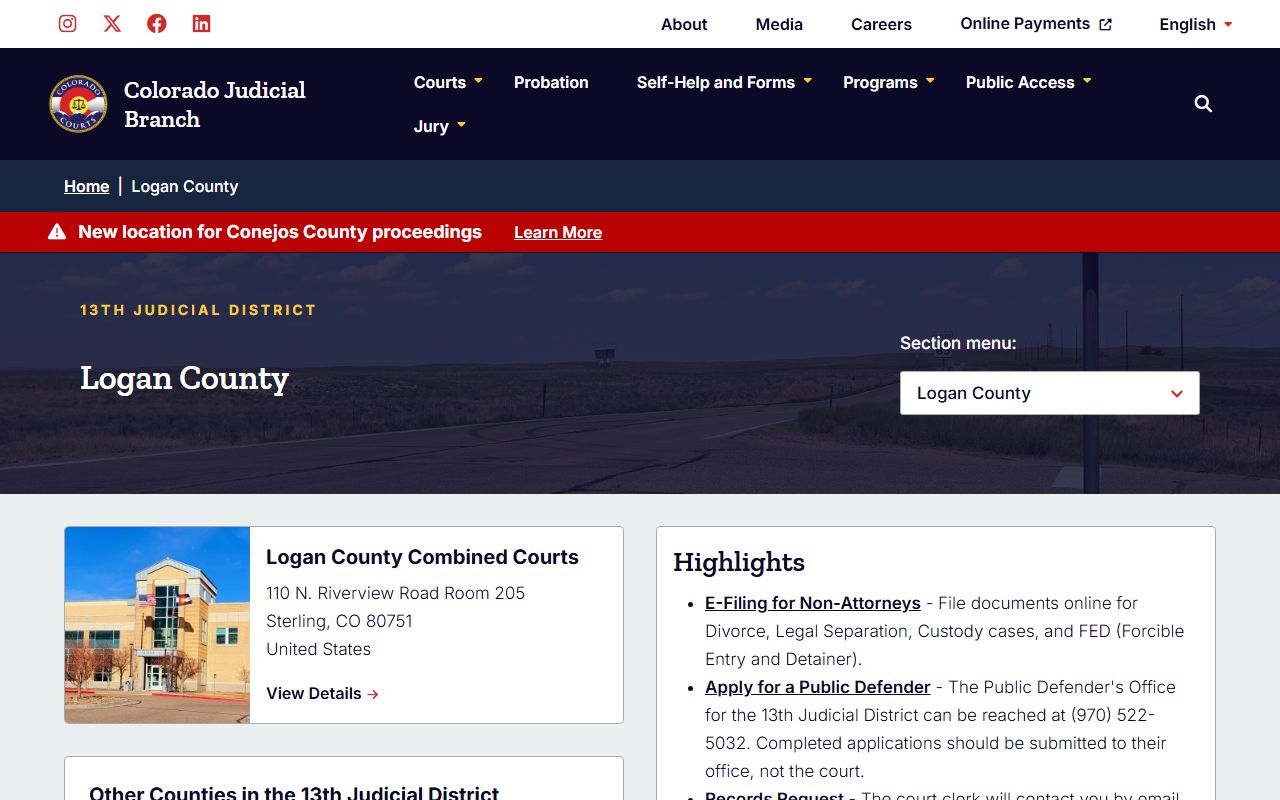
Logan County District Court
The 13th Judicial District Court serves Logan County from its courthouse in Sterling. This court handles family law matters, including divorce decrees, legal separations, and parenting time disputes. All dissolution of marriage cases for Logan County residents get filed here. The clerk's office can help you locate case files, request copies, and answer basic questions about court procedures. They cannot provide legal advice, but they can point you to forms and resources.
If you plan to visit in person, bring photo ID. Some cases involve sealed documents or confidential information that requires identity verification. The courthouse staff can search by names if you do not have a case number. This takes longer than searching by case number. Call ahead to check hours and any special procedures. Most routine requests for divorce decrees can be handled by mail or through the online request system.
You can learn more at the Logan County Court website, which provides contact information, directions, and links to forms. The court's main page offers details on office hours and how to reach the clerk's office by phone or email.
How to Get Divorce Decrees in Logan County
Start by using the online records request form provided by the Colorado Judicial Branch. This form routes your request to the correct courthouse. You will need the names of both parties in the divorce case. A case number speeds up the search. If you do not have it, the clerk can search by name, but this takes longer.
Fees apply for all copies. Certified copies cost $20 per document. Regular photocopies run $0.25 per page. If you were a party to the case, state rules cap your total cost at $15 no matter how many pages you request. This applies under Chief Justice Directive 06-01. Non-parties pay the full per-page rates. Research and redaction fees may apply if the request is complex. These fees are charged at $30 per hour after the first hour of work.
To find your case number, use CoCourts.com. This database, run by LexisNexis, lets you search by name for $10 or less. The results show the register of actions, which lists every filing and order in the case. You won't get the actual documents, but you will get the case number. Once you have that, submit your formal request to the Logan County clerk.
Mail requests go to the courthouse in Sterling. Include your name, contact information, the case details, and payment. You can also email the records department. Check the court's website for the current email address, as it may change from time to time.
Other vendors also provide court record searches. Background Information Services serves individuals and businesses. Tessera Data works only with businesses. Both pull data from Colorado court systems and charge fees for access.
Divorce Filing in Logan County
Colorado law requires one party to live in the state for 91 days before filing. This residency rule comes from C.R.S. § 14-10-106. The case gets filed in the county where either spouse resides. If one party lives in Logan County and the other does not, the case can still be filed here. The court has jurisdiction as long as one party meets the residency requirement.
After filing, Colorado imposes a mandatory 91-day waiting period. No divorce can be finalized faster than this. The court uses this time to ensure both parties have a chance to address property division, parenting time, and support issues. Some couples settle everything through mediation or negotiation. Others go to trial if they cannot agree on terms. The final decree cannot be entered until at least 91 days have passed since the court acquired jurisdiction over the respondent.
Colorado is a no-fault state. You do not need to prove wrongdoing by either party. The court only requires a finding that the marriage is irretrievably broken. This standard appears in the same statute that governs residency. It simplifies the process and avoids contentious disputes over fault.
When both parties agree on all terms and there are no minor children, the court may grant the divorce without a hearing. This process uses an affidavit under C.R.S. § 14-10-120.3. The judge reviews the paperwork and signs the decree if everything is proper. This saves time and court resources for straightforward cases.
Note: Filing a petition for dissolution in Logan County costs $230, which includes the displaced homemaker fee required under state law.
Contents of a Logan County Divorce Decree
A divorce decree includes the basic facts of the case. It lists both parties' names, the date of marriage, and the date the marriage was dissolved. If there are minor children, the decree sets out parenting time schedules and child support orders. The document divides property and debts. Real estate, bank accounts, retirement funds, and other assets get allocated between the spouses. Each party's share is stated clearly.
Spousal maintenance may be ordered in some cases. The decree specifies the amount and duration. It may also address tax issues, insurance coverage, and other financial matters. Both parties get a certified copy when the judge signs the final order. Under C.R.S. § 14-10-120, the decree is final when entered. Either party can appeal within the time allowed by court rules.
The clerk notifies the Colorado Department of Public Health and Environment about every divorce. This helps the state maintain vital statistics. CDPHE can verify that a divorce occurred, but they do not have copies of decrees. For actual documents, you must contact the District Court.
Online Search Options for Logan Cases
Most Logan County divorce cases appear in online databases within a few days of filing. CoCourts.com shows the register of actions for both current and past cases. The register lists every filing, hearing date, and court order. You can see when the petition was filed and when the decree was signed. But you cannot view the actual documents through CoCourts. For those, you must submit a formal request to the court.
The state's online records request form routes your request to the Logan County clerk. Staff will respond with instructions on how to get copies and pay fees.
Self-Help Resources
The Colorado Judicial Branch offers self-help forms and instructions for people handling their own divorces. These forms are free. They cover everything from filing a petition to drafting a final decree. The court website also provides step-by-step guides that explain what to file and when.
Form JDF 1011 is the petition for dissolution. Form JDF 1015 is the response. Form JDF 1019 is the final decree. All of these can be downloaded from the court's website. Logan County residents can use these forms just like anyone else in Colorado. The forms are standard across all districts.
If you need help and cannot afford a lawyer, contact Colorado Legal Services or a local pro bono program. Some organizations serve rural areas including Logan County. The court's self-help center can point you to resources in your area.
Privacy Rules and Access Restrictions
Most divorce decrees in Colorado are public records. Anyone can request a copy by following court procedures and paying fees. But some information may be sealed or redacted. Cases involving domestic violence or child abuse often have protective orders that limit access. Financial records with account numbers may be redacted for non-parties.
Under C.R.S. § 25-2-117, vital statistics records are confidential. Only people with a direct and tangible interest can get certified copies. This means the parties themselves, their attorneys, or people with a court order. If you think your case should be sealed, you must file a motion. The judge will decide based on the facts.
Historical Records and Archives
Logan County divorce cases from past decades may be held at the Colorado State Archives rather than the courthouse. The Archives does not have most recent records. If the divorce occurred in the last 30 or 40 years, the file is likely still at the District Court. Archives holdings vary by county and time period. Check with the court first before contacting the Archives.
Cases over 100 years old are fully open to the public. More recent cases have restricted access. You will need to provide proof of identity and relationship to the parties in some cases. The Archives staff can explain what they have and how to request copies.
Nearby Counties
Logan County borders several other counties. Sedgwick County is to the north. Phillips County lies to the east. Washington County is southeast. Morgan County sits to the west. Weld County is to the southwest. If your divorce was filed in one of these counties instead of Logan, you need to contact that county's District Court for records.
The 13th Judicial District covers seven counties in northeastern Colorado. Each county has its own courthouse. Make sure you know which county handled your case before requesting records.