
Gunnison County Divorce Decree Records
All Gunnison County divorce decree records are maintained by the 7th Judicial District Court in the town of Gunnison. This court serves six Colorado counties including Gunnison, Delta, Hinsdale, Montrose, Ouray, and San Miguel. The District Court Clerk in Gunnison keeps files for all local dissolution of marriage cases. People who need their Gunnison County divorce decree request copies from the clerk's office through in-person visits, mail, email, or the state's online records request system.
Gunnison County Quick Facts
7th District Court Records
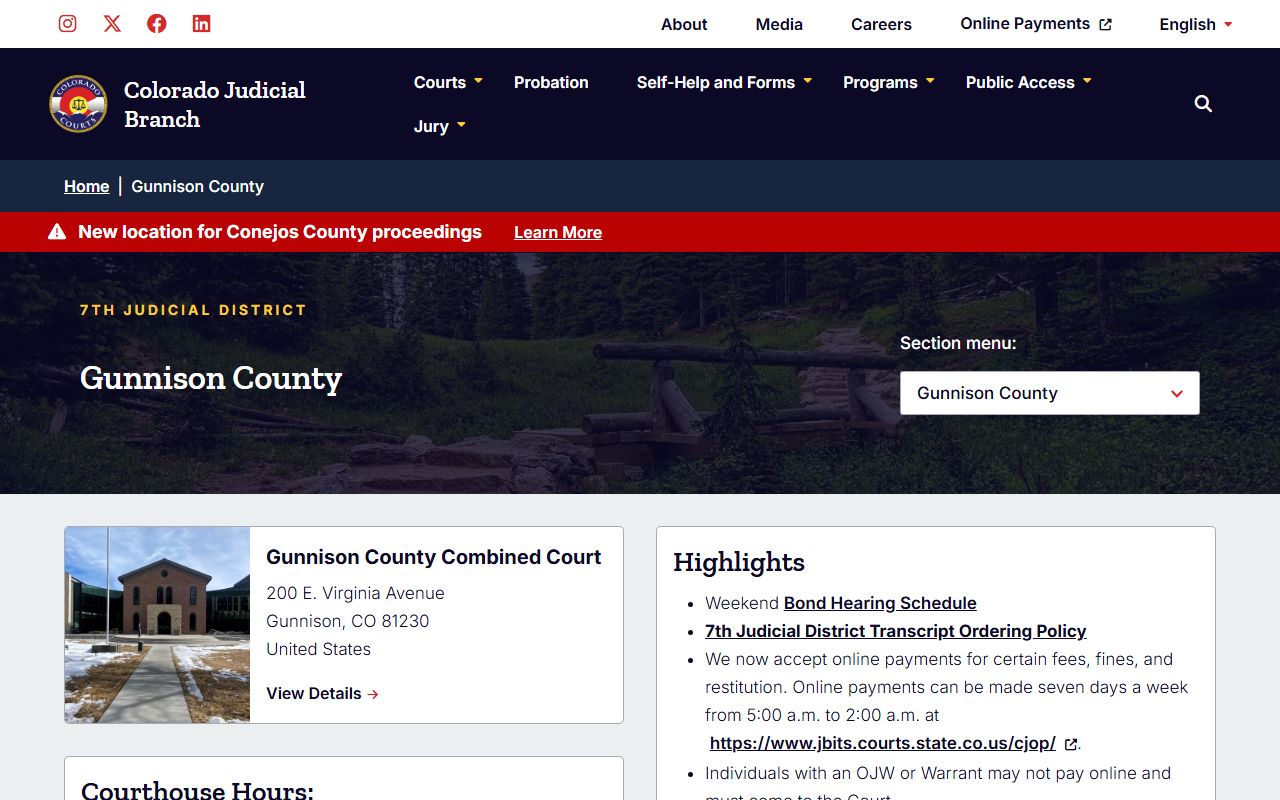
The Gunnison County courthouse is located in the town of Gunnison. All divorce filings for the county go through this location. The clerk's office keeps original case files including petitions, responses, financial disclosures, and final decrees. Visit during business hours to request copies or search for case information.
Walk-in requests let you get copies quickly if the file is readily available. Bring a photo ID and know the case number if possible. Without a case number, provide both parties' full names and the year the divorce was filed. The clerk can search the database and locate the file. Most people get copies the same day for recent cases. Older files may take longer if they need to be retrieved from storage.
The 7th Judicial District Court page for Gunnison County has current contact information. Check the website for phone numbers, office hours, and directions to the courthouse. The site may also have local forms and fee schedules specific to Gunnison County.
You can also request Gunnison County divorce decrees through Colorado's online system. Go to the state records request form and fill out your case details. Select Gunnison County and indicate you need a divorce decree. The court will contact you about fees and processing time within a few business days.
| County Seat | Gunnison |
|---|---|
| Judicial District | 7th Judicial District |
| District Also Serves | Delta, Hinsdale, Montrose, Ouray, San Miguel |
| Website | coloradojudicial.gov |
Requesting Your Divorce Decree
Mail requests work well for people who can't visit Gunnison in person. Send a letter to the Gunnison County District Court Clerk with your request. Include both parties' full names, the case number if you have it, and the approximate year of divorce. Add your mailing address and phone number so the clerk can contact you. The clerk will locate the file and let you know the copy fees. Pay when requested and they'll mail the documents to your address.
Standard Colorado court fees apply in Gunnison County. Regular copies are $0.25 per page. Certified copies cost $20.00 per document. If you're a party to the divorce, the maximum fee is $15.00 for all copies no matter how many pages. Non-parties pay the per-page rate. A name search costs $5.00 when you don't have a case number. Research fees of $30.00 per hour may apply after the first hour for complex searches.
You can call the Gunnison County clerk's office to ask questions before making a formal request. Staff can confirm whether a case exists, verify basic dates, and explain the process. They won't read entire documents over the phone, but they can provide helpful information about what you need to do to get copies.
Online Divorce Case Search
CoCourts.com offers online access to Gunnison County divorce case information. This statewide database includes all Colorado district courts. You can search by party name or case number. The service charges up to $10.00 per search and returns a Register of Action.
A Register of Action is a summary of case activity. It lists when the petition was filed, court hearing dates, and when the decree was entered. You see major case events but not the actual text of documents. Use the register to find your case number and verify key dates. Then contact Gunnison County District Court to get full copies of the decree.
Search Gunnison County records at cocourts.com. Other services like Background Information Services and Tessera Data also provide Colorado court record searches. These databases charge fees but offer convenient online access to case information.
Dissolution Process in Gunnison County
One spouse must live in Colorado for 91 days before filing a dissolution petition. This residency requirement is set by C.R.S. § 14-10-106. File at the Gunnison County courthouse if you or your spouse lives in Gunnison County and meets this requirement.
The petition for dissolution starts the legal process. File it with the District Court Clerk and pay the $230.00 filing fee. This amount includes a displaced homemaker fee required by Colorado law. If you can't afford the fee, ask about a fee waiver. The court provides forms for people who qualify based on income.
After filing and service on the respondent, a 91-day waiting period begins. The court cannot enter a final decree until 91 days have passed since acquiring jurisdiction over the respondent. This mandatory wait applies to all Gunnison County dissolution cases. During this time, parties can negotiate settlements, attend mediation, or request temporary orders for support or custody.
Many Gunnison County divorces settle without trial. When both parties agree on all terms, they can submit a stipulated decree. The judge reviews the agreement and signs the decree if it meets legal standards. Form JDF 1018 allows parties to get a decree without appearing in court for certain uncontested cases. This works when there are no minor children and the wife isn't pregnant, or when both sides have attorneys with a separation agreement. See C.R.S. § 14-10-120.3 for the requirements.
The decree becomes final when the judge signs it. Under C.R.S. § 14-10-120, it takes effect immediately even though there's a right to appeal. The clerk sends notice to the Colorado Department of Public Health and Environment, which creates a state verification record of the divorce.
Nearby Counties
Gunnison County shares the 7th Judicial District with five other counties. Each county maintains separate case files at their own courthouses. For divorces filed in those counties, contact the courthouse in that county.