
El Paso County Dissolution Records
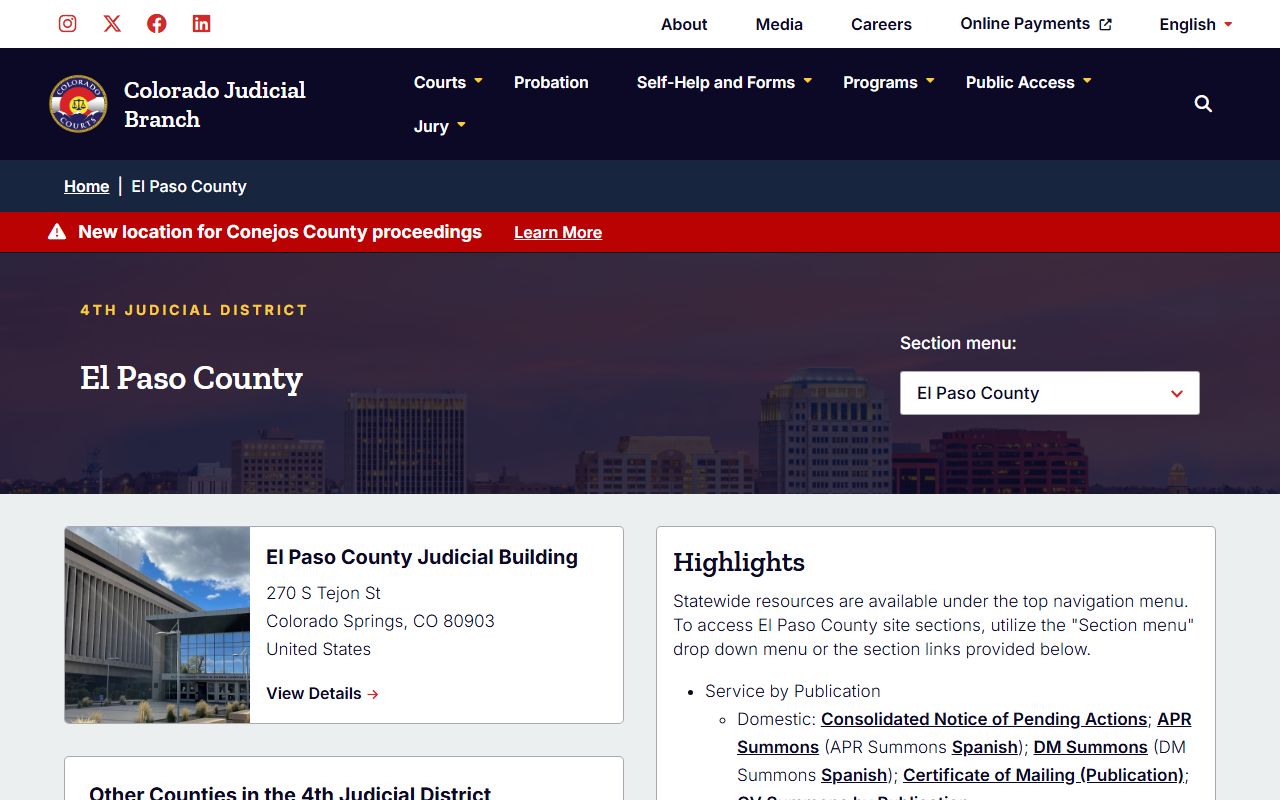
El Paso County maintains divorce decree records at the 4th Judicial District Court located at 270 S. Tejon Street in downtown Colorado Springs. The District Court Clerk processes all dissolution of marriage cases filed in El Paso County, which covers Colorado Springs, Fountain, and surrounding areas. When you need a divorce decree from El Paso County, you can request records in person, by mail, or through email to the records department. The court handles one of the highest volumes of family law cases in Colorado due to the county's large population, but staff maintain efficient processing times for most record requests. El Paso offers e-filing options for self-represented parties and runs a free childcare program called Court Care for parents conducting court business.
El Paso County Quick Facts
El Paso District Court Clerk
The Clerk of Court in El Paso County handles all divorce decree records and case filings. Sheri King serves as Clerk of Court for the 4th Judicial District. The main office is in the El Paso County Judicial Building at 270 S. Tejon Street. Hours are Monday through Friday from 7:30 a.m. to 4:30 p.m. for most services. The Records Department stays open until 5:00 p.m. to help with copy requests.
On the third Wednesday of each month, the Clerk's Office in Room S101 closes early at 3:30 p.m. The Self-Help Center also follows this schedule. Plan your visit around this if you need in-person help. Call ahead at (719) 452-5000 to check hours before driving to the courthouse.
The Records Department accepts requests through several channels. In-person visits work best when you need same-day copies. Staff can pull case files and make copies while you wait if the file is not archived. Email requests go to 04ResearchRequest@judicial.state.co.us with your case details. Include party names, approximate date, and case number if known. You can also mail requests to the Records Department at the Tejon Street address. Most requests are filled within three business days.
For questions about transcripts, use a different email: 04TranscriptRequest@judicial.state.co.us. Transcripts require a separate form and go to the court reporter. Regular record copies come from the Clerk's office only. The main phone line routes calls to the right department based on your needs.
| Location |
El Paso County Judicial Building 270 S. Tejon Street Colorado Springs, CO 80903 |
|---|---|
| Phone | (719) 452-5000 |
| Fax | (719) 452-5006 |
| Records Email | 04ResearchRequest@judicial.state.co.us |
| Hours | Monday-Friday, 7:30 a.m. - 4:30 p.m. Records Dept: 7:30 a.m. - 5:00 p.m. |
| Website | coloradojudicial.gov |
Getting Your Divorce Decree
Copy fees in El Paso County follow the local fee schedule. Paper copies cost $0.75 per page. This is higher than the state standard of $0.25 per page that most counties charge. Certified copies run $20 per document regardless of page count. Parties to their own case still get the maximum $15 cap that applies statewide, even with El Paso's higher per-page rate.
You need to provide basic case information when requesting a decree. The more details you give, the faster staff can locate the file. Helpful information includes both party names, filing date or decree date, and the case number if you have it. Without a case number, staff will do a name search for an additional $5 fee. If your request requires extensive research or redaction work, you may be charged $30 per hour assessed in 15-minute chunks after the first hour.
Most El Paso County divorce decrees are available immediately for parties to the case. If you filed or responded in the case, you have automatic access rights. Third parties may need to show proof of legitimate need. Bring government-issued photo ID when picking up records in person. For mail requests, include a copy of your ID.
Use the statewide records request form to submit your request online. Select El Paso County from the dropdown and choose "Divorce" as the case type. The form asks for party information and document type. Select "Divorce Decree" if that is all you need, or check other boxes if you want additional case documents like the petition or parenting plan.
Filing Options in El Paso
El Paso County offers electronic filing for non-attorneys in divorce cases. Self-represented parties can file dissolution petitions, responses, and other documents through the e-filing portal. This saves a trip to the courthouse. The system is available for divorce, legal separation, and custody matters. You create an account, upload your documents, and pay filing fees online.
The Self-Help Center in Room S116 assists people filing without a lawyer. Staff cannot give legal advice but can help you fill out forms and understand court procedures. They answer questions about filing requirements, service of process, and next steps in your case. The center maintains copies of all state and local forms for El Paso County dissolution cases.
El Paso County runs a Court Care program that provides free childcare for parents doing court business. If you need to meet with court staff, attend a hearing, or handle other court matters and have young children, Court Care can watch them while you take care of business. This program makes it easier to handle your case without finding a babysitter. Ask about Court Care when you visit the courthouse.
Online Divorce Case Search
CoCourts.com includes El Paso County in its statewide database. You can search for divorce cases by party name or case number. The database shows case filings, hearings, and decree dates. Searches cost $10 or less. Results show the Register of Action, which lists all events in the case but not the actual documents.
The Register of Action tells you when the petition was filed, when service occurred, hearing dates, and the date the decree was entered. You cannot view the decree itself through CoCourts. Use the database to confirm case details and the case number. Then contact the Clerk's office to get copies of the decree or other documents you need.
Other commercial services also search El Paso County court records. Background Information Services provides consumer searches. Tessera Data offers business-to-business court record access. These services pull from the same court database but may have different search interfaces or pricing.
Dissolution Requirements
Under C.R.S. § 14-10-106, one spouse must live in Colorado for 91 days before filing for dissolution. You file in the county where either spouse lives. Most El Paso County residents file in El Paso, though you could file elsewhere if your spouse lives in a different Colorado county. The filing fee is $230, which includes fees under C.R.S. § 14-10-120.5 for the displaced homemaker program.
After filing, a 91-day wait begins. The court cannot enter a decree until 91 days have passed since it gained power over the respondent. This usually means 91 days from service of the petition. The wait is mandatory. Even if both sides agree on everything, the court will not sign the decree until the 91 days are up.
El Paso County follows state procedures for uncontested dissolutions. When parties agree on all issues, they can request a decree without appearing in court. File form JDF 1018, which is an affidavit requesting the decree without a hearing. This works when there are no minor children or when both sides have lawyers and a signed separation agreement.
The decree must divide property, address debts, and set parenting time if children are involved. Courts look at what is fair based on each spouse's situation. Under Colorado law, marriage is dissolved when the court finds it is irretrievably broken. This is a no-fault standard. You do not need to prove wrongdoing. The court enters the decree when all legal requirements are met, and the decree becomes final immediately under C.R.S. § 14-10-120, though appeals are allowed.
Forms and Help
El Paso County provides local forms through the local forms page on the court website. These add to the statewide JDF forms that apply across Colorado. Local forms handle district-specific procedures or provide extra information about El Paso County rules.
Key forms for divorce include JDF 1010 for instructions on filing, JDF 1011 for the petition, and JDF 1015 for the response. The final decree uses form JDF 1019. If you file without a lawyer, read form JDF 1010 first. It walks through the steps.
Legal aid groups in El Paso County help low-income residents with family law cases. These organizations may provide free or reduced-cost help with divorce filings. Contact the Self-Help Center for referrals to legal aid programs serving the Colorado Springs area.
Older El Paso Cases
The Colorado State Archives holds some historical El Paso County divorce records. Cases from 1903 to 1941 are at the Archives. These older files are restricted for 100 years from the filing date, so only cases filed before 1926 are fully public now. To access historical records, search the Archives Search database using party names or case number.
Submit a formal request through archives.colorado.gov/request after finding the case. The Archives will pull the file and provide copies. Processing takes up to 10 business days. The Archives is located at 1313 Sherman St., Room 1B-20, Denver, CO 80203.
For El Paso County divorce cases from 1941 onward, contact the District Court Clerk. These files remain at the courthouse in Colorado Springs. Even cases from the 1950s or 1960s are still held by the court and have not been transferred to the Archives yet.
Cities in El Paso County
El Paso County includes Colorado Springs and Fountain, both of which have populations over 25,000. Residents of these cities file dissolution cases at the El Paso County District Court on Tejon Street in downtown Colorado Springs. The court serves all areas of the county.
Nearby Counties
Counties surrounding El Paso County each operate their own District Court for dissolution cases. File in the county where you or your spouse lives. The Clerk in each county maintains divorce decree records for that county only.