
Search Arapahoe County Divorce Records
Arapahoe County divorce decree records are held by the 18th Judicial District Court, which also serves Douglas, Elbert, and Lincoln counties. All dissolution of marriage cases in Arapahoe County are processed at one of two locations: the Arapahoe County Justice Center in Centennial or the older courthouse in Littleton. Both sites maintain full records access for divorce decrees filed in Arapahoe County. Staff can help you search for case files, request copies, or get certified decrees. One key thing: divorce records from 1992 to 2008 are stored off-site at the Colorado State Archives and require a special request process.
Arapahoe County Quick Facts
18th Judicial District Court
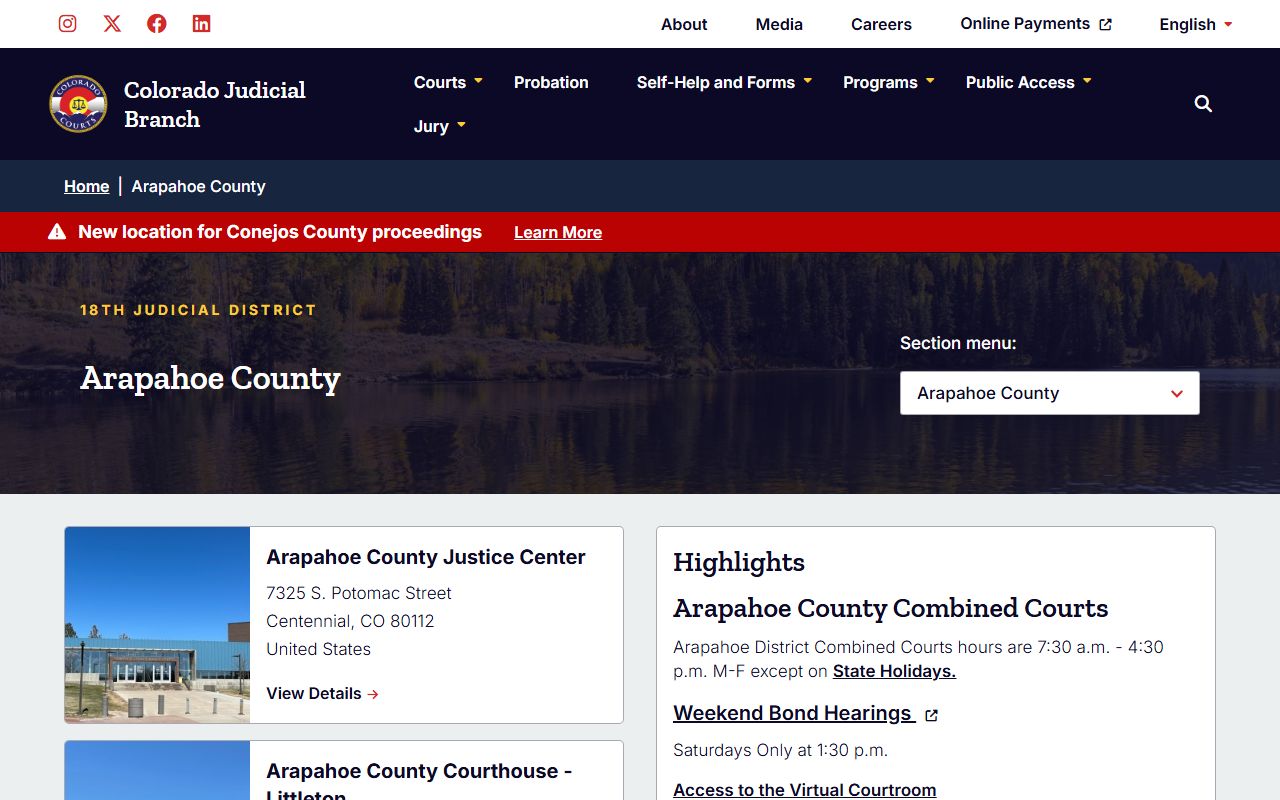
The 18th Judicial District operates two Arapahoe County court facilities. The Justice Center in Centennial is the main location. It sits at 7325 S. Potomac St., Centennial, CO 80112. The older courthouse in Littleton remains active at 1790 W. Littleton Blvd., Littleton, CO 80120. Both courts serve the same function.
Court hours run from 7:30 a.m. to 4:30 p.m. on weekdays. Most offices close on state holidays. Staff process divorce decree requests, answer questions about case status, and provide copies of court documents. The Clerk's Office handles all records inquiries. For any research requests or questions about Arapahoe County divorce decrees, email 18records@judicial.state.co.us. This email address serves both courthouse locations.
Arapahoe County added e-filing in October 2019. Self-represented parties can now file their own divorce petitions online without an attorney. Visit the Arapahoe County Court page to learn more about online filing. This service makes it easy to start a dissolution case or respond to a petition. The court website lists step-by-step instructions for e-filing domestic relations cases.
| Justice Center |
7325 S. Potomac St. Centennial, CO 80112 |
|---|---|
| Courthouse |
1790 W. Littleton Blvd. Littleton, CO 80120 |
| Hours | Monday-Friday, 7:30 a.m. - 4:30 p.m. |
| Records Email | 18records@judicial.state.co.us |
| Interpreter Email | 18interpreter@judicial.state.co.us |
| Probation | (720) 213-7800 |
| Website | coloradojudicial.gov |
Historical Divorce Records
Divorce records from 1992 to 2008 are held at the Colorado State Archives, not at the courthouse. This covers a 16-year span of Arapahoe County dissolution cases. If your divorce decree falls in this date range, you must contact the Archives to get a copy. Call 303-645-6814 for help with these records.
The Arapahoe County government website explains this unique situation. These files were moved to an off-site repository due to space constraints. The Archives staff visit this storage location about twice a week. This means your request may take longer than typical court records.
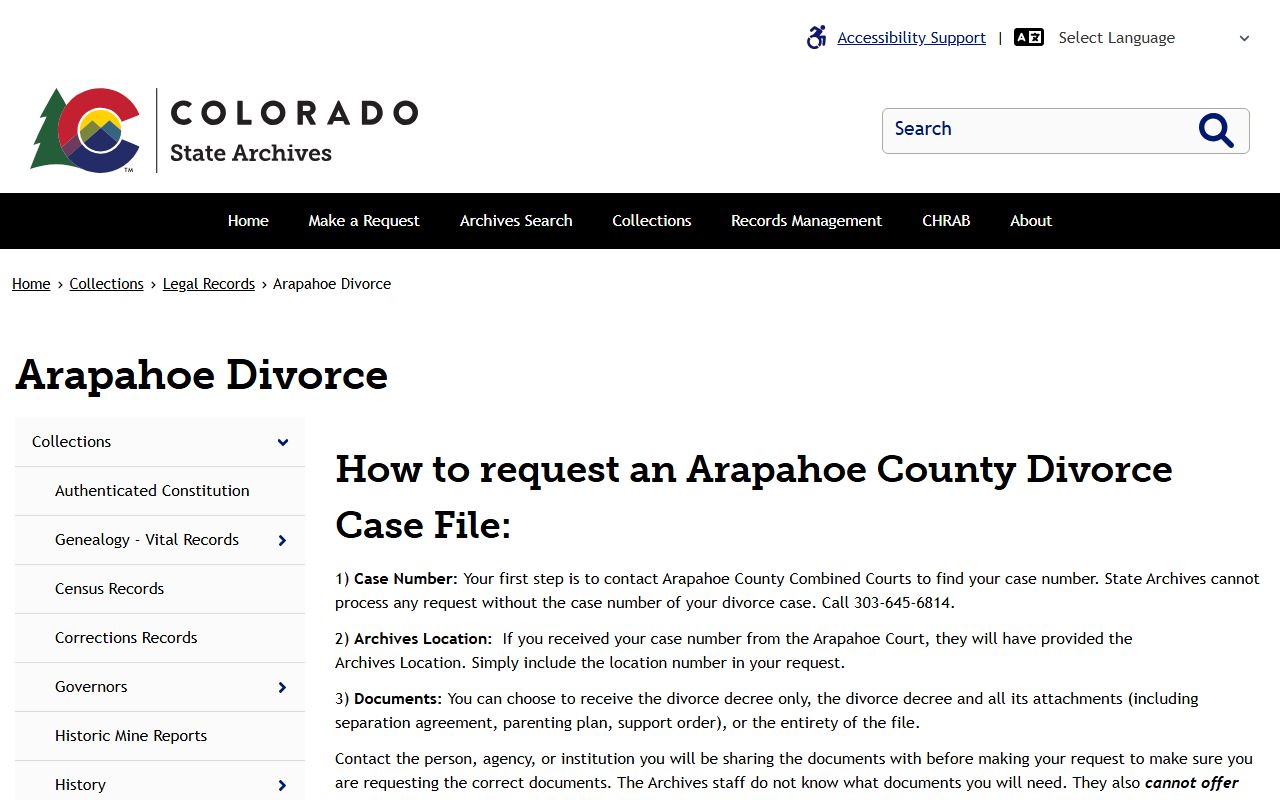
To request a decree from this time period, first get the case number. Contact Arapahoe County Combined Courts at 303-645-6814 to find the case number and verify the year. Once you have the case number, the staff will give you an Archives Location number. Then submit a formal request through the Colorado State Archives Arapahoe divorce page. You can choose to get just the decree, the decree with attachments, or the full case file.
In-person requests require an appointment with the Archives. Plan ahead if you need to view records on-site. For mailed copies, expect up to 10 business days after they receive your payment and ID. Fees follow standard Archives pricing. If your divorce was before 1992 or after 2008, contact the 18th District Court directly instead of the Archives.
Getting a Copy of Your Decree
For divorce decrees outside the 1992-2008 window, email 18records@judicial.state.co.us with your request. Include both party names, approximate date, and any known case details. Staff will search for the file and tell you the cost. Most research requests are completed in three business days or less.
You can also use the online records request form available through the Colorado Judicial Branch. Select Arapahoe County from the dropdown. Choose divorce from the case types. Fill in what you know about the case. The court will contact you with next steps. This form sends your request directly to the appropriate clerk staff.
Copy fees match the statewide schedule set by Chief Justice Directive 06-01. Standard copies are $0.25 per page. Certified copies cost $20.00 per document no matter how long it is. If you were a party to the divorce, you pay a max of $15.00 total. This cap does not apply to non-parties. Name searches are $5.00. Research and redaction work bills at $30.00 per hour after the first free hour.
Arapahoe County Online Search Tools
CoCourts.com lets you search Arapahoe County divorce cases from home or work. This database covers all 18th Judicial District cases including Arapahoe dissolutions. Searches cost $10.00 or less. You get a Register of Action that shows filing dates, court hearings, and when the decree was entered.
Keep in mind that CoCourts only provides case summaries, not actual documents. The Register of Action lists all docket entries but does not include the decree text. Use this tool to find your case number and confirm the filing date. Then contact the court or Archives to get the decree itself. Visit CoCourts to begin your search now.
Two other services provide Arapahoe County court records. Background Information Services offers both consumer and business accounts. Tessera Data serves business clients only. All three vendors pull from the same Colorado Judicial Branch database, so data should match across platforms.
Filing for Dissolution in Arapahoe
To file a divorce in Arapahoe County, one spouse must live in Colorado for 91 days first. This residency requirement is set by C.R.S. § 14-10-106. File your petition at the Clerk's Office at either courthouse location. The filing fee is $230.00 and includes a displaced homemaker fee under C.R.S. § 14-10-120.5.
Once you file, a 91-day wait begins. The court cannot sign your decree until 91 days pass after the respondent is served or files a response. This gives both sides time to work out terms or prepare for a hearing. Many cases settle during this time. If you agree on everything, you can file form JDF 1018 to get a decree without going to court. The judge reviews your paperwork and signs the decree if all legal requirements are met.
Colorado uses no-fault divorce rules. You do not have to prove your spouse did something wrong. The only ground for dissolution is that the marriage is irretrievably broken. Under C.R.S. § 14-10-120, the decree becomes final when entered by the court. The clerk sends notice to the Colorado Department of Public Health and Environment. This creates a state verification record but not a full copy of the decree.
Arapahoe Forms and Legal Help
The court provides free forms through the Colorado E-Forms system. Start with JDF 1010, which is a guide on how to file for divorce. Form JDF 1011 is the actual petition for dissolution. You also need JDF 1102, which is the summons that gets served on your spouse.
If you are served with divorce papers, respond using form JDF 1015. File this within 21 days to avoid a default. When you reach an agreement, use form JDF 1019 for the final decree. Both parties must sign if it is uncontested. Fill out forms completely and bring copies for the court and your spouse.
Self-Help Centers in Arapahoe County help people without lawyers. Staff cannot give legal advice but they can show you which forms to use. They check forms for completeness before you file. For complex cases or disputes, consult a family law attorney. The Colorado Bar Association can refer you to lawyers who take divorce cases in Arapahoe County.
Cities in Arapahoe County
Several large cities sit within Arapahoe County borders. Residents of these cities file divorce cases at the 18th Judicial District Court. Your city of residence does not change where you file. All Arapahoe County cases go to Centennial or Littleton regardless of what city you live in.
Other 18th District Counties
The 18th Judicial District includes Douglas, Elbert, and Lincoln counties in addition to Arapahoe. Each county has its own clerk office but they share the same district court judges. If you are unsure which county to file in, choose the one where you or your spouse lives.