
Alamosa County Divorce Decree Access
Divorce decrees in Alamosa County are maintained by the District Court serving the 12th Judicial District. This district includes Alamosa, Conejos, Costilla, Mineral, Rio Grande, and Saguache counties. When you file for dissolution of marriage in Alamosa County, your records stay with the Alamosa County Clerk at the courthouse in downtown Alamosa. The clerk's office handles all requests for copies of divorce decrees and related case documents. Whether you need a certified copy for remarriage or a standard copy for your own files, the staff can help you get what you need if you provide basic information about the case and show proper identification when required.
Alamosa County Quick Facts
Alamosa District Court Overview
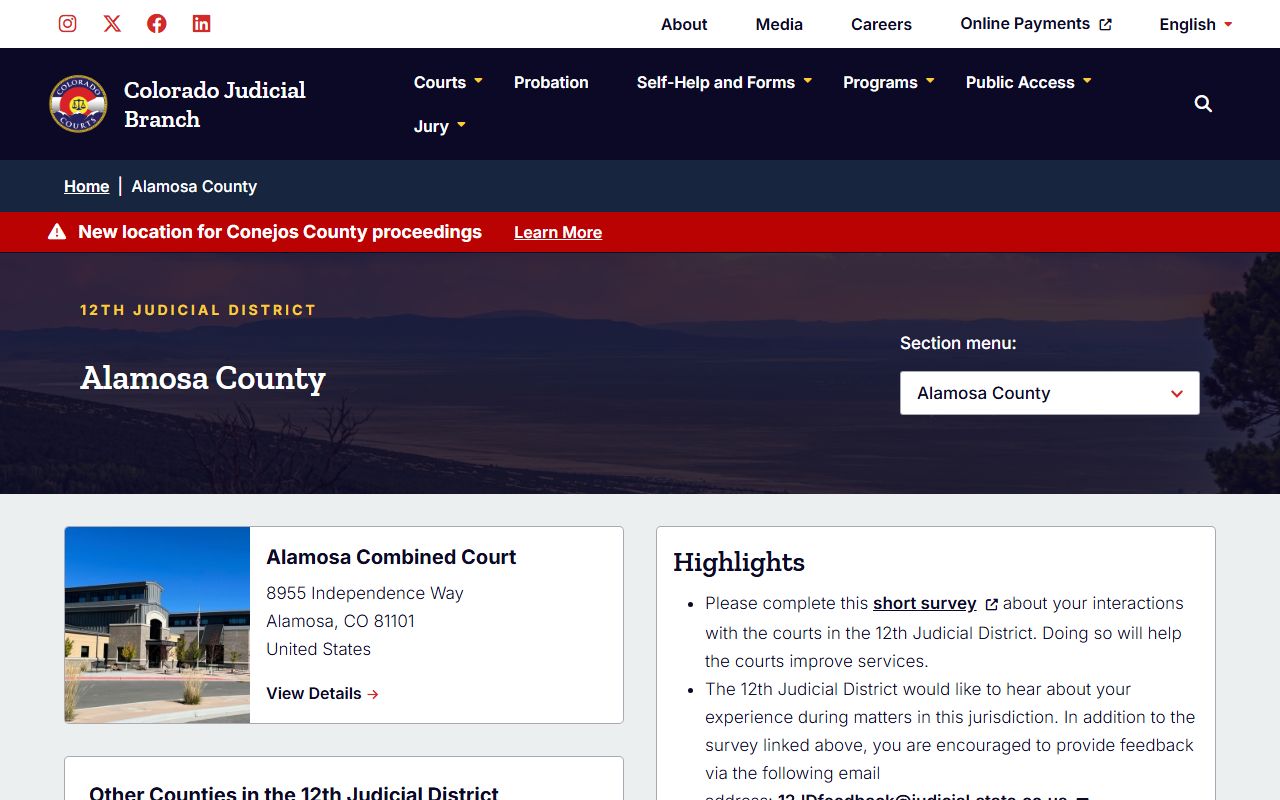
The Alamosa County District Court processes all divorce cases filed in the county. Located in the Alamosa Combined Court building on State Avenue, the clerk's office keeps divorce decree files and makes them available for public inspection and copying. Court staff answer questions about how to request records and what fees apply to different types of copies.
Alamosa shares judicial district judges with five other counties in the San Luis Valley. Cases rotate among judges assigned to the 12th Judicial District. Even though judges serve the whole district, each county maintains its own clerk's office and case files. If you filed your divorce in Alamosa County, that is where your records stay.
Most requests get processed within a few business days. The clerk can provide copies while you wait if you come in person and the file is readily available. Older files stored off-site take longer to retrieve. Call ahead to ask if your case is on-site or if it needs to be pulled from storage.
| Location |
Alamosa Combined Court 702 Fourth Street Alamosa, CO 81101 |
|---|---|
| Phone | (719) 589-6947 |
| Hours | Monday-Friday, 8:00 a.m. - 4:30 p.m. |
| Website | coloradojudicial.gov |
How to Request Alamosa Divorce Records
In-person requests work best when you need certified copies quickly. Visit the clerk's office on Fourth Street during business hours. Bring a photo ID if the case involves you. Tell the clerk you need a divorce decree and give them the case number or names of both parties. They can search their system and locate the file. If it is on-site, they make copies while you wait. Pay the copy fee before leaving with your documents.
Online requests go through the Colorado Judicial Branch records request form. Choose Alamosa County from the list. Fill in the form with party names, approximate filing date, and what documents you want. The clerk reviews your request and contacts you about fees. Once you pay, they send the copies by mail or make them available for pickup.
Mail requests also work for Alamosa County. Write a letter with your name, contact information, case number or party names, and what records you need. Send it to Alamosa Combined Court, 702 Fourth Street, Alamosa, CO 81101. The clerk will reply with the total cost for copies. Send payment, then wait for your copies to arrive by mail. This takes longer than in-person visits but works if you live far from Alamosa.
Fees are set by state law. Copies cost $0.25 per page. Certified copies are $20.00 per document regardless of length. Parties to their own divorce pay a maximum of $15.00 for copies no matter how many pages. Non-parties pay the per-page rate with no cap. A name search fee of $5.00 applies if you need the clerk to find your case number. Complex research requests cost $30.00 per hour after the first hour of clerk time.
Divorce Filing Requirements in Alamosa
To file in Alamosa County, you or your spouse must live here. Colorado law under C.R.S. § 14-10-106 requires 91 days of residency before filing. You file a petition at the clerk's office and pay the $230.00 filing fee. This fee includes court costs and the displaced homemaker fee.
After you file, a 91-day waiting period begins. The court cannot enter a final decree until 91 days after it gets jurisdiction over your spouse. This gives both parties time to settle property, support, and parenting issues. You can ask for temporary orders during the wait if needed. The 91-day rule applies to all Colorado divorces, not just Alamosa.
When both parties agree on all terms, you can finalize the case without a court hearing. Form JDF 1018 lets you submit an affidavit instead of appearing in court. The judge reviews your agreement and signed documents. If everything meets legal requirements under C.R.S. § 14-10-120.3, the decree gets entered. This saves time and avoids a court appearance.
Alamosa County follows statewide procedures and forms. You can download form JDF 1010 for the petition and JDF 1019 for the final decree from the Colorado Courts forms library. Instructions are included with each form. If you need help, the divorce self-help page explains each step.
Searching Alamosa Divorce Cases Online
CoCourts.com includes Alamosa County in its statewide court record search. You can search by party name or case number for $10.00 or less. The results show a Register of Action with case events like the filing date, hearings, and when the decree was entered. This helps you verify the case number and basic facts before requesting copies from the clerk.
The online search does not give you the actual divorce decree. It only shows the case docket and activity log. To get the decree itself, contact the Alamosa County Clerk after finding the case online. The search just makes it easier to locate the right case and confirm it exists in Alamosa County.
Other commercial services search Colorado court records too. Background Information Services offers searches for individuals and businesses. Tessera Data provides business-to-business access. These pull from the same state court system as CoCourts but may have different pricing or features.
Historical Divorce Records
Older Alamosa County divorce records may be at the Colorado State Archives. The Archives does not hold recent Alamosa divorces. Check their divorce records page for which years they have from Alamosa County. Most people looking for recent divorces should contact the court directly, not the Archives.
If your case is old enough to be at the Archives, you need the case number and year to request it. Search the Archives database online. Submit a request through their portal if you find the case. Processing takes up to 10 business days. The Archives is in Denver at 1313 Sherman Street.
Access to Divorce Decrees
Most divorce decrees are public records in Colorado. Anyone with a direct interest can request copies. You get easier access to your own divorce records as a party to the case. Attorneys, family members with legal needs, and others with tangible interests can also request records. Some case files have sealed portions if they involve protected information like children's addresses or financial account details.
When a decree is entered, the clerk sends notice to the Colorado Department of Public Health and Environment as required by C.R.S. § 14-10-120. CDPHE maintains a verification index but not full decrees. For actual decree copies, you must contact the Alamosa County Court.
Alamosa County Residents
Alamosa County does not have cities with populations over 25,000. All county residents file divorce cases at the Alamosa District Court on Fourth Street. The city of Alamosa is the county seat and largest population center, but dissolution of marriage cases are handled at the county district court level regardless of where in the county you live.
Other 12th Judicial District Counties
These counties share the 12th Judicial District with Alamosa County. Each maintains its own clerk's office and divorce decree files. Make sure you file in the county where you or your spouse actually resides.